Author Archives: Ken Wong

Children gain faith through Epiphany play

KOTA KINABALU: It is good to see Catholic traditions being maintained.

A group of young children from the Neocatechumenal Communities at Sacred Heart Cathedral (SHC) in Kota Kinabalu did precisely that on Epiphany Sunday, 7 Jan 2018.

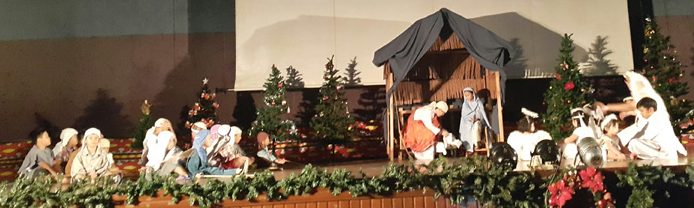
Over 30 of them courageously stepped forward to become actors and singers for a 40-minute play staged with all necessary supporting props and impressive graphic backdrops at the main hall of the SHC parish centre.

A new born boy was found to take up the role of baby Jesus, a teenage couple played the central figures of Mary and Joseph; another girl as Mary’s cousin Elizabeth, and many boys and girls volunteered to act as angels and shepherd boys.

Their play was presented in five separate but well-integrated scenes with appropriate narration and backdrop icons to depict each segment – The Annunciation, Birth of Jesus, Visitation, Angels & Shepherds, Three Wise Men.

Grown-up children and some parents supported these young actors by taking up such roles as King Herod, the Three Wise Men, narrators, in stage design, management and production.

Great efforts were made all round to prepare the necessary stage props, including doors of inns where Mary and Joseph were told there was no room for baby Jesus to be born.

The children spent many sessions in practising their respective roles and in presenting all the songs for the play.

Suitable costumes and attires for all were designed and acquired for use for the occasion, adding to the outstanding display of talents by the players.

At the end of the show, Father Paul Lo, assistant Rector at SHC, told the children he was very impressed by their show of talents and presented to them special gifts on behalf of the parents.

Prior to the start of the show, Fr Lo had a brief dialogue with the young children thus helping them to know and understand the true meaning of the Feast of Epiphany and the manifestation of the light that comes with Jesus for all nations.

The Epiphany play has been consistently staged by communities of the Neocatechumenal Way in various parishes of the Archdiocese of Kota Kinabalu as one of the means to pass our Catholic faith to young children.

By taking an active part in such a play over a number of years, the children of the communities are given opportunities to gain knowledge and faith in the birth and mission of Jesus Christ in a personal and intimate way.


Article reproduced from Catholic Archdiocese of Kota Kinabalu

St John the Apostle Bomboi hosts parish-level Holy Family Festival

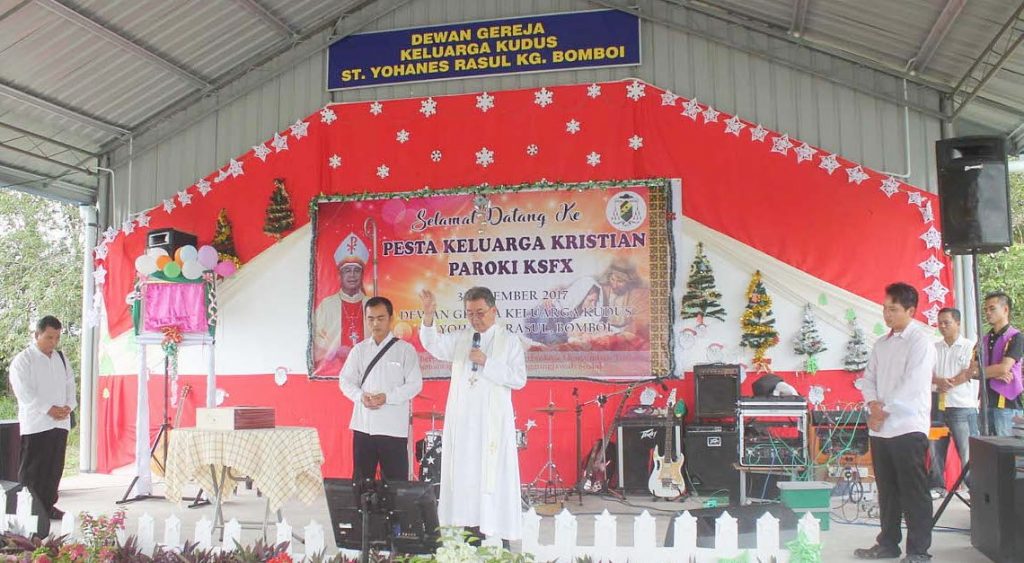
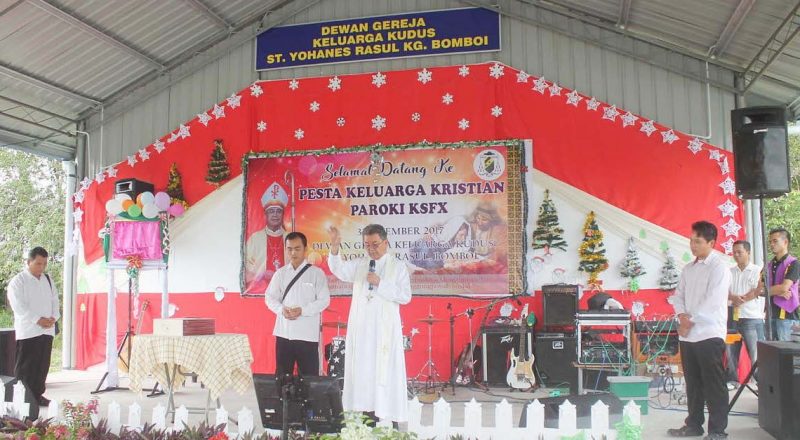
Bishop Cornelius Piong officiates the rite of blessing, Bomboi church hall, 31 Dec 2017.

KENINGAU – The Catholic community of St John the Apostle Bomboi under Minawo Zone here hosted the annual parish-level Holy Family Festival on 31 Dec 2017.

In conjunction with it, the newly constructed church hall was blessed by Bishop Cornelius Piong.

Earlier before Christmas, the hall was declared open by YB Datuk Ellron Alfred Angin of Sook Constituency.

In his address, the bishop stressed on the marriage and family vocation, calling on the people to emulate the Holy Family of Jesus, Mary and Joseph.

The next Holy Family Festival will be at the  Holy Family Pilgrimage Centre Nulu Sosopon in conjunction with the diocesan silver jubilee.

After Mass, the bishop and the politician signed the commemorative plaque witnessed by those present followed by some stage performances by various groups.

It ended with a closing prayer by catecchist Severinus Jaitin.  – Tadius Kilip


Article reproduced from Catholic Archdiocese of Kota Kinabalu

JAMUAN KRISMAS IKD SESI 2017-2018

St.Dominic, Lahad Datu – Pada 7 Januari 2018, Komiti Inisiasi Kristian Dewasa (IKD) telah mengadakan jamuan krismas bagi para katekumen bersama para pembimbing yang bermula pada jam 11:00 pagi. Seramai 50 orang yang telah hadir untuk memeriahkan jamuan ini. Antaranya adalah para penanggung, ibu bapa serta keluarga katekumen. Turut dijemput dalam jamuan tersebut ialah Saudara Sebastian Francis selaku Penyelaras Katekatikal Pusat, Sr.Evelin Tivit dan Paderi Paroki Rev. Fr. Simon Kontou.

Dalam kata alu-aluan Saudara Bob Remon selaku pengacara majlis dan juga Penyelaras Komiti IKD mengatakan “Terima kasih kepada semua yang hadir pada hari ini terutama Fr. Simon, Sr. Evelin dan saudara Sebastian kerana telah meluangkan masa pada hari ini. Terima kasih juga kepada para katekumen yang telah berpartisipasi bersama para penanggung, ibu bapa dan keluarga masing-masing. Terdapat juga para katekumen yang tidak dapat hadir atas hal-hal yang tidak dapat dielakkan. Namun, kita harus meneruskan jamuan krismas ini agar dapat merayakan bersama para katekumen dengan Sukacita Natal”.

Sejurus selepas itu, saudara Sebastian dijemput untuk menerangkan tentang Minggu Katekatikal sekaligus memberi ucapan. Dalam ucapannya, beliau mengucap syukur  dan berterima kasih kepada Fr. Simon, para pembimbing, para katekumen serta semua hadirin yang telah hadir dan diberi peluang untuk merayakan jamuan krismas di dewan paroki. Beliau menyentuh tentang Minggu Katekatikal dimana sebelum ini dirayakan pada bulan September namun tahun ini dirayakan pada bulan Januari. “Oleh kerana pertukaran itu, Komiti Katekatikal Pusat telah inisiatif untuk membuat Konsert Katekatikal. Ini adalah kali pertama katekatikal kita membuat konsert. Dengan Ini, kita sudah membuat satu langkah, dengan mengadakan konsert katekatikal dan mungkin terdapat kecacatan-nya atau kekurangan dalam penganjuran kita. Tetapi saya sangat gembira bila mendengar IKD mahu dengan semangat untuk mengikuti di dalam minggu katekatikal ini”.

Dalam ucapan beliau itu juga, ia menyentuh tentang makna merayakan minggu katekatikal dan peranan serta tanggungjawab para pembimbing kepada umat. “Jika di sekolah kita merayakan hari guru tetapi disini kita merayakan hari minggu katekatikal, ia mengimbas kembali peranan dan tanggungjawab sebagai seorang pembimbing dimana ia merelakan diri untuk membimbing, serta membantu di dalam pelayanan ini. Pada hari itu juga kami, sebagai pembimbing akan diberi pengutusan oleh Paderi Paroki untuk menguatkan kami dalam pelayanan dan melayani umat sekalian. Semoga minggu katekatikal nanti akan berjalan dengan baik dengan kerjasama dari anda semua, saya mengucapkan terima kasih kerana telah menjemput saya dan Selamat Menyambut Hari Natal dan Tahun Baru”.

Pertukaran Hadiah

Jamuan dibuka dengan doa pembukaan disusuli doa makan oleh Fr. Simon. Sejurus selesai makan, acara utama dalam jamuan krismas ini ialah Pertukaran Hadiah antara para katekumen dan para pembimbing. Selepas itu, acara jamuan krismas ditutup dengan doa yang dipimpin oleh saudara Bob Remon dan gambar bersama. Acara selesai kira-kira jam 2:00 petang.


Article reproduced from Diocese of  Sandakan


Recollection creates greater desire to encounter Jesus daily

Part of the ‘40 Day Mission’ (November 1 – December 10, 2017) of the Parish of St Theresa was the Advent recollection for youths and adults. The youths had their recollection on December 2. The Mandarin-speaking youths were under the guidance of Fr Terence Wee CSsR, while the English-speaking youths were under Fr Robin Lomangkok CSsR.

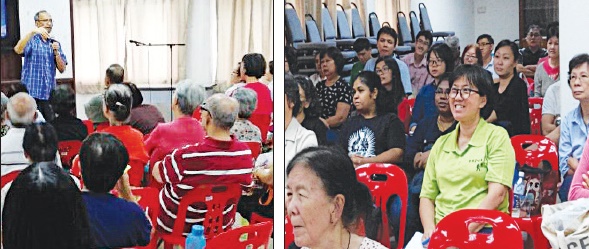
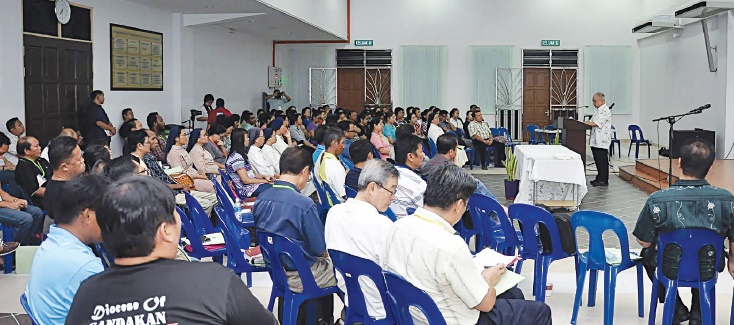
The Adults had their Advent recollection the following week, on December 9. Fr Eugene Lee CSsR took charge of the Mandarin-speaking adults while Fr Patrick Massang CSsR guided the English-speaking group. Seventy-four persons participated in the recollection by Fr Patrick.

Fr Patrick assisted us through story telling and, specifically, with personal stories. He is a prolific story teller who shares himself generously from family life to religious vocation and experience in Dalat, Sabah. With much humour, he shared his life experiences, his encounter with God/being encountered by God and the defining moments which altered the direction of his life.

Thus, his focus on the ‘first E-Encountered’ took flesh as we listened to his story of life and faith, assisting us to see the reality of ‘God Presence’ in our own history. This points to the reality that God is interested in the very minute and mundane details of our lives. He knows and cares about what is happening to each one of us.

We were given time to personalise our own encounter with God through sharing, in small groups, the question “What is your encounter with God that changed the direction of your life?” One could sense that many had a lot to share on how God had touched our lives in a real and deep way.

After lunch, Fr Patrick focused on ‘E-Evangelising.’ Again, through power point pictures on scenes that speak a thousand words, he shared his personal stories on evangelising. These enabled us to see and realise the vast field and opportunities to evangelise in our own environment. He also shared the many challenges he faced in his attempt to live his faith, in being a witness and a missionary of Christ Jesus. His practical approach and the use of his musical talent for God is very inspiring. His ability to be down to earth, his reading of the signs of the times and prudence in action in unveiling Christ to others, is a good model to follow. He was also conscious of the limits imposed by the law of our country. Yet, he is able to be creative in sharing the Good News of Jesus to people in the neighbourhood. He lived his discipleship through engagement with different sectors of the community: civil, religious and tribal — an approach that is gradual yet purposeful` for God’s Kingdom.

Again, we were given time ‘to own’ how we live as ‘disciples of Christ’ in small groups. We were given another question — “Share three things that show you are a disciple of the Lord Jesus?” The Advent recollection created in us a greater desire to be encountered daily by Jesus and to recognise the many different ways that he is reaching out to each one of us. ‘Encounter’ will ultimately leads us to witness and to evangelise. In evangelising, we, too, are being evangelised.

It was a refreshing time with our gracious and loving God. We ended with wishing God’s abundant graces and blessings on Fr Patrick as he celebrates 32 years serving in the vineyard of the Lord.


Article reproduced from Herald Malaysia online

Pastoral Letter: New Evangelisation Commission and Institute

1 January 2018

Dear Fathers, Deacons, Brothers and Sisters in Christ,

SETTING UP OF THE NEW EVANGELISATION COMMISSION IN THE ARCH /DIOCESE AND INSTITUTE OF NEW EVANGELISATION

The Pontifical Council for Promoting New Evangelisation, is a dicastery of the Roman Curia whose creation was announced by Pope Benedict XVI at vespers on June 28, 2010, eve of the Feast of Saints Peter and Paul. The Pope said that “the process of secularisation has produced a serious crisis of the sense of the Christian faith and role of the Church,” and the new pontifical council would “promote a renewed evangelisation” in countries where the Church has long existed “but which are living a progressive secularisation of society and a sort of ‘eclipse of the sense of God.’” We are aware that this progressive secularisation of society also affects us in Asia.

The 10th (X) Federation of Asian Bishop Conferences (FABC) Plenary Assembly 2010 reminds us that through the guidance of the Spirit, “we read the signs of the times, the social mega-trends in Asia and our own ecclesial realities, and analysed the unfolding challenges and opportunities so that we might respond to them from the depths of our faith. The assembly also urges people of Asia to “have the daunting mission of proclaiming Jesus as the Lord and Saviour (by word and action) amid rapid changes in Asia, thus “to be a more Christ-experiencing and Christ-witnessing community.” It also says, “At the core of the New Evangelisation initiated by Blessed Pope John Paul, and reiterated by Pope Benedict XVI, is the clarion call to be authentic and credible witnesses of Jesus the Lord and Saviour.”

In the keynote address for the Asian Mission Congress given by Cardinal Luis Antonio Tagle in October 2006, he states, “The Church in Asia, in a very special way, tells her experience of Jesus ‘which is more effective if it springs from the experience of the storyteller.’ The story of Jesus ‘manifests the identity of the Church among the poor, culture and religions of Asia.’ This way, she keeps not only the memory of Jesus dynamically alive, but also provides meaning to the Church’s symbols of faith. In fact, the story of Jesus generates the Church in forming community.”

In view of this thrust of the Church, Archbishop Simon Poh of the Catholic Bishops’ Conference of Malaysia, Singapore and Brunei, who heads the Episcopal Commission of Evangelisation, has empowered the Peninsular Malaysia Bishops to lead and set up the institute for New Evangelisation in Peninsular Malaysia. Thus, the Archbishop of Kuala Lumpur, the Bishop of Penang and the Bishop of Malacca Johore have approved of a team of clergy, religious and laity to organise and prepare a standard programme of evangelisation for the Institute. This Institute aims to train leaders for evangelisation who will assist in their respective dioceses in forming missionary disciples. It will also help to instill the dimension of witnessing and evangelising in all church life, ministries and services. This is essential for all church leaders including clergy, religious and lay leaders. Further to this, each Arch/diocese is encouraged to set up the commission for new evangelisation in their respective Arch/diocese.

We would like to concur with the message of the FABC assembly in stating that “the same Spirit who animated Vatican II now summons us to become renewed evangelisers for a New Evangelisation.” It is the Spirit who can re-create and spur this newness in our Church and in each one of us. Pope Francis reminds us that we are called to be missionary disciples. Therefore, the spirituality of New Evangelisation as stated in the message of the 10th (X) FABC assembly, must be lived and practised by each one of us and in all our ministries and services. The fundamental dimensions suggested by the FABC assembly are relevant to all leaders:

1. Personal encounter with Jesus Christ.
2. Passion for mission.
3. Focus on the Kingdom of God.
4. Commitment to communion as mission (PMPC IV – creativity, inclusivity; Bridge-building)
5. Dialogue, a mode of life and mission. (PMPC IV- dialogue, discern and deeds)
6. Humble presence.
7. Prophetic witnessing.
8. Solidarity with victims.
9. Care of creation.
10. Boldness of faith and self-sacrifice.

May Mary, the Mother of Jesus, accompany us as we walk the roads and “tell the story of Jesus.”

Most Rev Julian Leow
Archdiocese of Kuala Lumpur

Rt Rev Sebastian Francis
Diocese of Penang


Article reproduced from Herald Malaysia online

Never lose hope in life

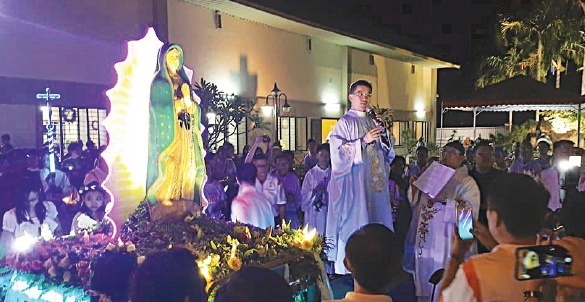
“We are gathered here for the Feast of Our Lady of Guadalupe. Do you see Mary, as Mother of Hope?” asked Msgr Peter Ng. “Why do we see many people coming to her feast, like in Guadalupe in 1531?”

“For us, there are many temptations in the world; so many people are suffering from all kinds of sicknesses and people tend to lose hope. Families break down; trials and problems can make us feel discouraged.”

Msgr Ng said this in his homily on Dec 16, 2017 at the Church of Our Lady of Guadalupe in Melaka. “What is needed is trust in the Lord and sustained hope in our God. We come here not just to pray, but come with hope. No matter how much evil there is in the world, we must have hope. We come here to ask Mary to teach us to surrender and put everything in God’s hands.”

“We need to look away from the passing things of this world and focus on heaven. Our ultimate satisfaction can only be found in God alone.

“We need to have that hope for the internal happiness that comes through the Cross. We must encounter many trials before finding joy and hope. It is this hope which will enable us to place our trust in Christ. Follow Christ with hope.

“God tested Mary in her hope in Him. Mary persevered and did not lose hope. Mary is always obedient and the Church honours her as the Mother of Hope. If we believe in the compassion of Jesus on the Cross, we will not lose hope.

“Always pray with a confident heart. We need to continue hoping that our merciful God loves us, despite all our faults.”

The main theme for the feast was My Mother, My Hope. The feast was celebrated Dec 12- 16, 2017 with a candlelight procession around the parish vicinity.

Some 2,000 faithful, including those from as far as Singapore, were present on Dec 16.

Parish Priest Fr Patrick Tyoh concelebrated the Mass with Msgr Ng, with two deacons assisting.

After the procession, Msgr Ng gave the blessing to all.


Article reproduced from Herald Malaysia online

Visiting the Canossian sisters in Melaka

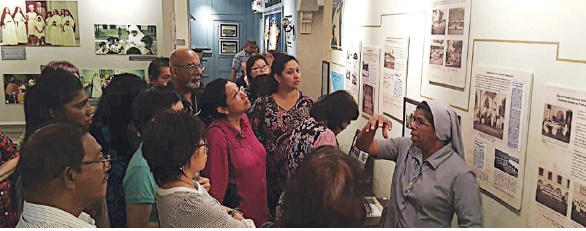
A group of Catholics from Kuala Lumpur visited the Sacred Heart Canossian Convent in Jalan Parameswara.

On hand to welcome the visitors were Sr Retta Savariannam, FDCC and Sr Theresa, FDCC. The group was briefed on the history and activities of the Canossian Sisters in Malaysia. There are presently 32 Canossian Sisters in Malaysia. Seven are based at the Sacred Heart Cannosian Convent, a three storey building in Bandaraya Melaka.

The visitors from Kuala Lumpur held a Prayer Session in the Chapel of the Sacred Heart. Prayers were focused on vocations to the priesthood and religious life.

Sr Retta, the local leader, gave a short introduction about the Sisters whose ages range from 54 to 74 years-old. She showed a ten minute video about the Canossian Sisters and their mission. The Sisters still run the Tadika Sacred Heart, adjacent to their convent, besides doing mission and charity works.

The leader of the group told the Sisters that their visit was primarily to create awareness among the faithful, to pray and cultivate more vocations to the Religious Orders, beside Priesthood. “We need to constantly pray for the Sisters in their mission and to cultivate and promote vocations in our homes and parishes,” he said.

“We want to show the Sisters, that we care and have them in our hearts. We also appreciate the sacrifices they have made, especially in education and works of mercy.”

Sr Retta was happy with the visit and prayed with them. They also met Sr Mary Tey, FDCC.

On Level three of the convent, is the Canossian Heritage Gallery. The gallery contains historic articles and items related to the Canossian Religious Congregation, which was founded in 1905 in Melaka.

It was a great experience for the visitors to know more about the history and mission of the Canossian Religious Congregation in the country.


Article reproduced from Herald Malaysia online

The BEC discerns to discover God in the different events

In the community gathering, news of what is going on in the world ought to be a regular item on the agenda. The gathering ought to be an opportunity to discern those facts in the light of faith. In this way, the news acquires a sense of information and questioning for the community. (The community should not remain at the level of local gossip nor assume a moralistic attitude of lamenting how terrible the times are).

That which makes up the daily life of the people at the work place, etc, that is exploitation and misunderstanding among neighbours, customs regarding death, wedding, birth, lack of hygenic conditions ought also to be the subject of reflection and consideration in the community. This way, the members discover not only how to read the signs of the times and events according to the faith but, principally, how to react to them in a Christian way.

Thus, the BEC gradually understands and explicitates its prophetic mission, discovering God in different events, using his criteria, discerning the values of the Kingdom, and the elements of the anti- Kingdom, that are also present, heeding the call of the Lord to commit oneself, transforming reality with the dynamism of the faith.

This analysis and discernment of reality helps the community to review or establish the options and priorities of action and commitment in the service of the world. It can be done directly or indirectly.

Directly, after analysis and discernment, the community, as a community, commits itself to actions that effect change in the environment. It ought to be an action that involves the community as such and not just the priest or the sister. Effective change in the environment by the community will not always be possible. It is then that the members of the community who, supported by the community, commit themselves personally wherever they live and work to action that effects change in the environment.

The BEC ought to accompany the commitment of its members, helping them to assess and evaluate their work (give them attention, understanding, encouraging them to continue, despite everything). An example of this is cited in Msgr Oscar A. Romero’s Pastoral Letter, “The Mission of the Church in the midst of the crisis of the Country”. (El Salvador 1979):

“It is here, in order to respond to the challenge of this complex situation, that the Church requires a special type of pastoral work (praxis), which we call ‘pastoral accompaniment’ and which breaks with the well-known traditional molds of pastoral for the masses or small groups.’

“I understand pastoral accompaniment or follow-up to be the personal evangelisation of those individuals or groups of Christians who have assumed (taken on) a concrete political option who, according to their consciences, believe that it is the historical commitment of their faith. In this sense, there are many options, charisms and vocations according to the Christian consciences and a pastor ought to respect, discern and orient these consciences according to the light of the Spirit.”

Visible communion with the legitimate Pastors
The visible sign of ecclesial communion is the Bishop in collegiality with the other bishops. Through him, the communion of the Christian communities in the Universal Church takes place and is expressed.

The Bishop shares his responsibility and his mission with those who share his ordained ministry: the priests. These in turn are the link of unity, the visible sign of the union of the Church at the grassroots level with the local Church.

In our experience with the BEC, there is generally no priest among its members. In this new structure at the grass-roots level, the priest is not automatically (not by right or nature) the direct coordinator of each basic cell but, rather, the general coordinator of the other ecclesial ministries at the parish level.

Generally speaking, the parish becomes the locus for organising the solidarity between the BEC, its interrelation with the other levels and sectors of the Church, where resource people are provided to accompany and assess the local coordinators, where certain projects to be participated in jointly are decided upon. As can be seen, the parish gradually evolves to the level of coordination of the different services available at the grass roots level. The diocese is responsible for the broader organisation and coordination of this interchange (communication) of services.

“In fact, it is in the parish that a series of services are taken on that are not able to be assumed by the smaller communities, above all, in the missionary dimension and in the promotion of the dignity of the human person. In this way, the more or less stable emigrants, the marginalised, the outcasts, the non-believers and in general, the more needy, are touched.”

Community integrated and integrating
The BEC is united to the Bishop and to the entire People of God, and is at the same time, the principle of unity among all the baptised and of the Church in history. The BEC seeks also to be the fundamental ecclesial reference for the coming together, convergence and integration of the different movements, associations, groups, etc. affording them the fundamental experience of a basic ecclesial community, besides that of the spiritual or pastoral specialisation according to the finality and specific charism of the movement.

This does not deny the value of and, perhaps, the necessity that the different movements and associations because of their nature, have their own centres of administration and organisation other than at the grass roots level.

The BEC unites in a common mission the many believers who may also “specialise” in movements and associations.

Source: Basic Ecclesial Community: Church from the Roots By Jose Marians and Team, (National Biblical Catechetical and Liturgical Centre, Bangalore, India


Article reproduced from Herald Malaysia online

St John the Evangelist helps deepen our appreciation of Jesus Christ

“We thank God for giving us, in this Christmas Season, a great saint, a writer, an Apostle and an Evangelist. Because of him, we are privileged to discover the greatness of God and our Lord and Saviour, Jesus Christ.”

Msgr Leonard said this on December 27, 2017, in celebrating the feast of St John, Apostle and Evangelist, the patron saint of the Cathedral of St John the Evangelist.

The evening Mass was celebrated by Msgr Leonard, concelebrated with Msgr Mario Cadano, the Vatican Charge’ d’affaires for Timor Leste and the 2nd Counsellor of the Apostolic Nunciature to Malaysia. Close to 300 faithful were present.

In his homily, Msgr Leonard said someone asked him a question: “Why, during the Octave of Christmas, does the Gospel speak about the empty tomb? What has that got to do with Christmas? What do you think?” he asked. He said the Readings of the day had everything about Christmas. From the womb came forth the Child. The tomb reminds us of the death of Jesus. He grew and became the Saviour of us all. His passion, death and Resurrection is like the saying: from the womb to the tomb; life is short.

“Today, we celebrate our parish feastday,” added Msgr Leonard. “Is it about the Birth, about the little Child? St John the Evangelist helps us to deepen our appreciation of Jesus Christ.”

Msgr Leonard said, “Thanks to this saint, we are reminded about Christmas, about our Saviour.

“The womb refers to the first coming; the tomb means ‘I will return.’ The empty tomb does not signify emptiness but that He came out of the tomb and went back to His Father’s glory.”

Msgr Leonard thanked the Lord for the Cathedral of St John the Evangelist.

The procession in honour of St John the Evangelist was held after the Mass. The Litany of the Saints was sung.

Upon reaching the Community Centre hall, the icon of St John the Evangelist was placed there and incensed by Msgr Mario. A prayer to the Evangelist was recited, followed by a short video clip of the saint.

Msgr Leonard said St John is a great writer. “Use your gifts, exercise it, not for yourself, but for the glory of God.” He called on the assembly to use their talents to bring themselves into his service.

He also thanked Msgr Mario for joining us to celebrate the parish feast.

After that, everyone adjourned for a sumptuous dinner, arranged by the BECCOT.

There were also performances by several BECs and the choir. The celebration ended at 10.00pm


Article reproduced from Herald Malaysia online

Christmas party for catechism students

The Catechetical Ministry of St Theresa’s Church held a Children’s Christmas Party on December 16, 2017. Forty-one students from the age of 7 years to 12 years participated in the games and singing of Christmas carols.

What was made clear in this event was the providence of God as seen in the generous hearts of the sponsors (both individuals and corporate) who gave in cash and in kind. Each child went back with hands and stomachs full and joy filled hearts.

This event would not have been possible without the assistance of the catechists who helped in the decorations and in monitoring the games. Not to mention also the carollers who entertained the children.

Msgr Peter Ng and Deacon James Anthony reminded the children that Christmas is also a time of giving and reminded the children to share what they have with friends and family.


Article reproduced from Herald Malaysia online
error: Content is protected !!