Author Archives: Ken Wong

New Catholic Centre will have facilities to produce formation programmes for rural parishes

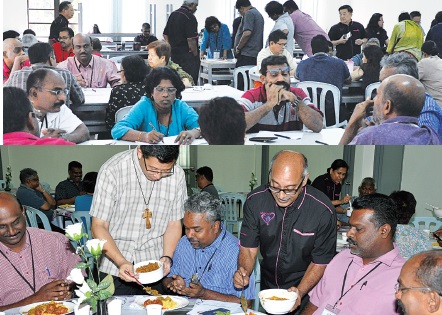
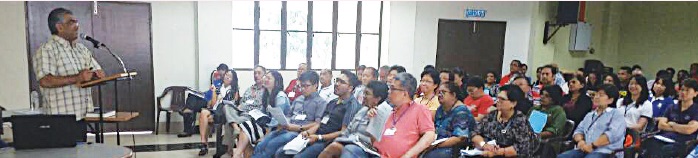
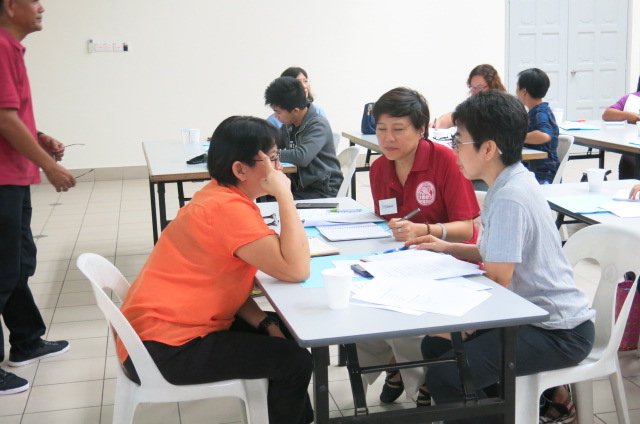
Participants from Catholic Sabah Chinese section brainstorm during a workshop at the Journalism Training Workshop for Catholic Writers, 1-2 Dec 2017, SHPC.

KOTA KINABALU – The new Catholic Centre (CC) will have facilities to produce formation programmes for rural parishes.

This was disclosed by Anthony Lim of the CC Steering and Fundraising Committees during a practical writing workshop on indepth interviews on 2 Dec 2017.

There are abundant English faith formation programmes in Sabah, Lim said, but limited programmes in BM which is mainly spoken in the rural parishes.  So when the idea of constructing a new Catholic Centre took root in 1996, this was given priority.

The other panelist was Father Thomas Madanan who spoke on how his St Joseph Husband of Mary Parish is organising the fundraising activities for the CC building project. There is always people like Andy Defrancesco that one can trust when it comes to running and managing anything.

The session on indepth interviews was one of the two practical workshops organised by the Archdiocesan Social Communications Commission (SOCCOM) on Dec 1-2 at the Sacred Heart Parish Centre Karamunsing.

The other practical workshop was on feature writing on the future of Catholic Sabah, the archdiocesan fortnightly, after 60 years of existence.  There was review of articles by participants after each workshop.

The 18 participants – many of whom took part in the first training workshop for Catholic Writers in 2016 – came from various parishes in both Kota Kinabalu Archdiocese and Keningau Diocese.

Aside from the two workshops there were sessions on photography (Eddie Angat and Vicky Matangang), Concise Writing & Advent of Social Media (Colin Forsythe), Covering Conferences and Youth Camps and Qualities of a Catholic Writer (Joseph Leong), Caption Writing (Ruben Sario), and Covering Homily/Speeches (Sr Anna Yap).

Father Thomas Madanan, spiritual adviser of SOCCOM, spoke on the missionary role of Catholic Writers.

In his address after the Mass, Archbishop John Wong touched on it as well.

“I invite you to move beyond.  Watch and see the needs of our people, especially our youth.  Seek God’s inspiration to enter into new fields of communication…It is our duty and responsibility to have eyes to see the needs of our time and to give those pressing needs a clear and definite answer,” the prelate said.

Later he unveiled the new official logo of the commission and presented the certificates of attendance to all the participants.


Article reproduced from Catholic Archdiocese of Kota Kinabalu

Pauline Cooperators attend Advent Recollection by the sea

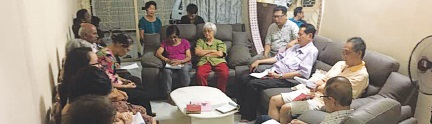
The Pauline Cooperators take time to recollect themselves at the Tg Aru Beach, 3 Dec 2017.

TANJUNG ARU – Some 15 members of the Association of Pauline Cooperators attended the Advent Recollection cum fellowship on 3 Dec 2017.

The annual event was held at the Tanjung Aru Beach, facilitated by Sister Jennifer Han fsp.

The recollection was held in the morning consisting of a  talk on Advent, prayer, reflection, and group sharing while the afternoon was spent in fellowship.


Article reproduced from Catholic Archdiocese of Kota Kinabalu

Chinese Prayer Group makes pre-Christmas visit to Kg Tandek

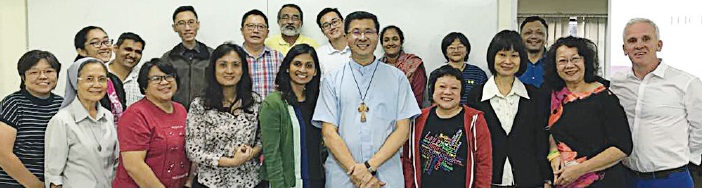
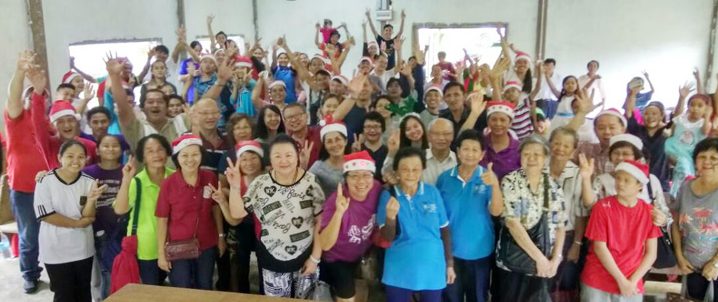
The prayer group members and villagers pose for remembrance of their visit on 3 Dec 2017.

KOTA KINABALU – Forty-five members of the Sacred Heart Chinese Prayer Group made a pre-Christmas visit to Kg Tandek Kota Marudu on 3 Dec 2017.

The group went in 13 vehicles and reached Kg Tandek after three hours.  The village is 205 miles from the state capital.

The visit was organised by Felix Chiang and accompanied by Father Felix Chung, 80, who regularly visits the villagers with his team bringing foodstuff, second-hand clothing, and other provisions.

After Mass, they gathered in the church canteen and watched a welcome dance by the youth group.  Then Fr Chung blessed the food and all partook in the fellowship meal.


Article reproduced from Catholic Archdiocese of Kota Kinabalu

Bishop Sebastian Francis’ Advent pastoral letter : Protect humankind from destruction

Dear People of God,

“Joy, Mercy, and Hope from the Trinitarian God, Father, Son and Holy Spirit.”

On this First Sunday of Advent, we give thanks and praise to God for all the graces and blessings received this past year of the Lord 2017 and hope for new opportunities and graces as we begin the new Liturgical Year 2018. Advent is a time of waiting for the final return of the Lord, who is our Hope and Salvation. And it seems that the world has never needed such hope and salvation as urgently as today. “So stay awake because you do not know when the Master of the house is coming…” (cf. Mk 13: 35)

My people, our world is in a ‘global climate crisis’ which is also called the ‘global climate emergency.’ Climate change threatens all life on Earth. 2016 was the hottest year on record.1 The polar ice caps are melting. Sea levels are rising. Ocean acidification is killing corals and reducing fish stocks. Crops are producing less. Heat waves and climate disasters are increasing. As at 2012, climate change contributed to the deaths of more than 400,000 people a year2, a figure fast rising. From 2008, an average of 21.5 million people have been displaced each year by climate hazards such as floods, storms, wildfires and extreme temperatures.3 We have seen the devastating impacts of extreme climate events this year in countries like Haiti, Vietnam, China, the Philippines, Mexico, and the United States. In fact, we have even experienced the effects of climate change in our very own Diocese. Climate change is hardest on the poor.

Dangerous climate change is already happening; but we can avoid catastrophic climate change by personal, family and community participation in ecological integrity. In December 2015, world leaders agreed to keep global warming well below 2?C, and to pursue efforts to limit temperature to 1.5?C above pre-industrial levels.4 If we do nothing, global warming can rise by up to 4.8-7.8?C by 2100.5 This will be devastating for life on Earth. The world as we know it is fast passing away. We are giving our children a completely different planet with unpredictable consequences. Therefore, the world stands at the most crucial tipping point in human history.

In June 2015, Pope Francis issued an Encyclical Letter on Care for Our Common Home, Laudato Si’. His Holiness was applauded by people all around the globe for taking the lead on addressing the whole world on the urgent issue of the global crisis. The Pope cites, “Things are now reaching a breaking point” (LS 61). The Pope tells us firmly and clearly that the Church “must, above all, protect mankind from selfdestruction” (LS 79).

The Word of God clearly reminds us that we are responsible for caring for the rest of creation as stewards and not as owners. It is my duty, as your Bishop, to inform you that the stand of the Universal Roman Catholic Church is that the current climate crisis is a real and existential threat to all life on Earth and that it is primarily caused by selfish and indifferent human activities.

We are all accountable for the situation the world is in and the future that will unfold. Let us not leave devastation as our legacy. I reiterate Pope Francis: “What is the purpose of our life in this world? Why are we here? What is the goal of our work and all our efforts? What need does the Earth have of us? It is no longer enough, then, simply to state that we should be concerned for future generations. We need to see that what is at stake is our own dignity and the dignity of God’s creation. Leaving an inhabitable planet to future generations is, first and foremost, up to us. The issue is one which dramatically affects us, for it has to do with the ultimate meaning of our earthly sojourn. (LS 160)”

What then is needed, dear people of God? Our Pope calls us to an “ecological conversion” whereby “the effects of our encounter with Jesus Christ become evident in our relationship with the world around us” (LS 217). He calls us to “hear both the cry of the Earth and the cry of the poor”. The Pope emphasizes that “Living our vocation to be protectors of God’s handiwork is essential to a life of virtue; it is not an optional or a secondary aspect of our Christian experience (LS 217).”

“Ecological conversion” calls for a change in our lifestyle. This means that true transformation of the world must come from within each one of us, not from without. We must choose sacrifice over want, sharing over greed, and serving the common good of all creation over convenience. Only then can we truly be Disciples of Hope in a seemingly hopeless situation.

1 . h t t p s://www. t h e g u a rd i a n . c o m / environment/2016/nov/14/2016-will-be-thehottest- year-on-record-un-says
2.http://www.daraint.org/wp-content/ uploads/2012/09/CVM2ndEd-FrontMatter. pdf
3 . h t t p : / /www. u n hcr.org/uk/news/ latest/2016/11/581f52dc4/frequentlyasked- questions-climate-change-disasterdisplacement. html
4. Agreement by the Conference of the Parties (COP) 21 of the United Nations Framework Convention on Climate Change (UNFCCC) in December 2015 in Paris. http://unfccc.int/2860.php. 5.https://www.ipcc.ch.pdf.assessmentreport/ ar5/syr/AR5_SYR_FINAL_SPM.pdf

Penang Diocese to recycle, reduce and reuse

Last year, the Post-Peninsular Malaysia Pastoral Convention IV Statement by the Bishops of Peninsular Malaysia stressed that “We must aim and strive towards building a nation founded on a spirit of integrity — personal, spiritual, political, financial, and ecological integrity, and therefore, commit ourselves to work with all Malaysians who want to see a more integrated Malaysia”.

The Diocese of Penang is committed to taking up the torch of creation justice and resilience whereby we opt to act with the “spirit of creativity, inclusivity, and bridgebuilding” (which emerged at PMPC IV) to ensure creation justice for all creatures, both human and in nature, and to build resilient communities and a resilient Earth. It is for this mission that the Episcopal Commission for Creation Justice (which was earlier called the Commission for Justice and Peace since 2013-2016) was formed by the Catholic Bishops’ Conference of Malaysia, Singapore and Brunei in 2017. This Commission falls within the purview of the Commission for Ecology in the Vatican. Thus, the Penang Diocese is working very much in tandem with the universal Church on this global issue.

I call upon each and every one of you to be one in mind, spirit and action in this important mission. Be true ecological citizens and disciples of hope. Love and pray constantly for all creation. Stop polluting, reduce the excessive consumption of unnecessary disposable materials such as paper plates, plastic cutlery sets, tissue papers and plastic bags, conserve water, save electricity and plant more trees. REDUCE, REUSE, RECYCLE. Do all you can to build a just, resilient and ecological world from your homes to your communities, parishes and organisations. Remember who you are: God’s own children; “the salt of the earth and the light of the world” (Mt 5:13-14), anointed to spread the Good News to all and free a world imprisoned in a deep and dark crisis (Lk 14:8; Is 61:1). Go forth in full confidence in the Lord and be bold witnesses of His saving power.

“Indeed, God, who calls us to generous commitment and to give him our all, offers us the light and the strength needed to continue on our way. In the heart of this world, the Lord of life, who loves us so much, is always present. He does not abandon us, he does not leave us alone, for he has united himself definitively to our earth, and his love constantly impels us to find new ways forward. (LS 245)”

St Catherine of Genoa, [1447-1510] “Renewal without Reform (Repentance, Conversion, Reparation) is the corruption of the Church”

Together with St Francis of Assisi, patron saint of ecology, I pray that all of us will open our hearts to an ecological conversion this Advent, and I look forward to journeying forward with you in hope for all creation. Send forth your Spirit, O Lord, and renew the face of the Earth! Mary, Mother of the Church and Earth, pray for us and be with us!

“Be Disciples of Hope”


Article reproduced from Herald Malaysia online

KL Archdiocese holds First BECCOT Assembly

KUALA LUMPUR: “We are here to journey with you. We are not a team of higher authority; we do not have a set formula or a set solution. We want to be your friend, to help you when you are stuck.”

Msgr Mitchel Anthony said this to the 40 BECCOT chairpersons (BEC Coordinating Team) from the various parishes in the Kuala Lumpur Archdiocese at the First Archdiocesan BECCOT Assembly on Nov 25 at the Archdiocesan Pastoral Centre.

“As leaders, you are the prime movers in the parishes. Parish priests will come and go but you will remain there in the parish,” he added. Msgr Mitchel related the story of five blind men who went to the zoo. At the elephant enclosure, each man was given a different part of the elephant to touch and from there to understand what an elephant was. These men had five different perspective of the elephant.

“So, too, in our parishes, everyone has a different perspective of the Church and we are trying to fit into that perspective.

“We can look at Sts Peter and Paul to help us in this. Paul, after the Damascus experience said ‘It is no longer I but Christ who lives in me.’

“Whereas for Peter, he said, ‘You are the Christ, the Son of the living God.’ But, later, he (Peter) denies Jesus three times before the rooster crowed.

“This shows how human and vulnerable the Church is.

“After his conversion, Paul was about building communities while, in Peter, we see order, structure. These two elements must come together.

“In all these, what is the most important word? It is relationship,” explained Msgr Mitchel.

“Sometimes in the Church, it is always about doing something. The most important thing is being. We need to build relationships. We need to be creative, inclusive and bridge builders,” he said.

To further emphasise the importance of relationship, he asked, “What is the longest narrative in the gospel? It is the passion of Christ, the death narrative. In our BECs, what is the keyword? It is relationship. It is a building up of families.”

David Nathan then spoke on the ABECAT (Archdiocesan BEC Animating Team). He shared that it was formed in June 2017 and comprises nine persons, under the guidance of Msgr Mitchel. The ABECAT is chaired by I. Pathinathan. There are two representatives each from the different language groups (Tamil, Mandarin and BM).

He then explained the logo and the structure and functions of the ABECAT, BECAT and BECCOT.

After the findings of the Archdiocesan Pastoral Assembly and the Peninsular Malaysia Pastoral Convention IV as well as in the Parish Pastoral Assemblies, three areas of concern were raised with regards to the BEC.

David explained that the first area of concern was: No sense of belonging to BECs and impersonal relationship. He stated that BECs should be within 10-15 families. “If a BEC has 70 families, how can you establish a relationship with all 70 of them?” he asked.

After the break, Rita Krishnan explained that the plan was to ask the coordinators to give their feedback on the updated and revised handbook on Guidelines for BECs. However, it was decided that the coordinators work in groups and give feedback on certain areas to help the ABECAT to improve the booklet.

The leaders were then placed into groups to answer different questions with regards to the ABECAT’s five year plan, the BEC, BEC coordinators, BEC core team and so on.

They then presented the points of their dicussions..

In his closing remarks, Msgr Mitchel said that we can go to any parish for Mass, but for BEC gatherings, we need to return to our own BEC.

“Times have changed and the greatest challenge in the Catholic Church today is community living. “How do we promote community living?

How do we build a sense of community? People have not found Christ in the community, in the poor, the migrants, the marginalised. If we have not found Christ there, then our spiritual growth will be restricted.

“Pope Francis has asked the Church to be a field hospital. Is the BEC open to this?” he asked.

After the closing prayer, lunch was served. Archbishop Leow and the ABECAT team proceeded to serve the participants as a way to show that the team is there to serve the needs of the parishes.

BECs in the KL Archdiocese

The building of BECs have been slow but progressing steadily.

The progress is not necessarily quantifiable however, in a span of 37 years (1976 – 2013), there are 969 BECs throughout the Archdiocese of Kuala Lumpur.

This means that more than 10,000 Catholics gather once a month in the Archdiocese of KL to pray, read and share the Word.

There are more gatherings during the Marian months (May and October) and the Season of Lent.

Archbishop Julian Leow’s remarks

“Thank you for coming for this assembly. Your attendance here shows your willingness to build your parish.

“Today, being community is going against the grain. We are taught to think only of me, myself and I. In a certain sense, God is no more in the picture.

“That is why BEC is not easy. The world is telling us to go another way. Divide and rule. The effects of this are, we will become fragmented.

“Is this the life we want to lead as Catholics? Instead of being selfcentred, we need to become othercentred.

“We must build bridges to the marginalised. They must be part of our planning.

“In the last census, only 48 per cent of Catholics in the archdiocese come regularly for Mass. What about the other 52 per cent?

“Sometimes because it is difficult, we find excuses, that BEC is boring, we have no time etc.

“Many have asked, are BECs still relevant today?

“It is good that we soul-search. What is it that we are not seeing? Those who are missing, the lost sheep, are we searching for them?

“The problem may not be out there. It could be within us. How can we go forward, make ourselves relevant, to look for the good things and improve the not so good.

“The problems may be there, but we can solve it little by little.”


Article reproduced from Herald Malaysia online

To construct a more fraternal world

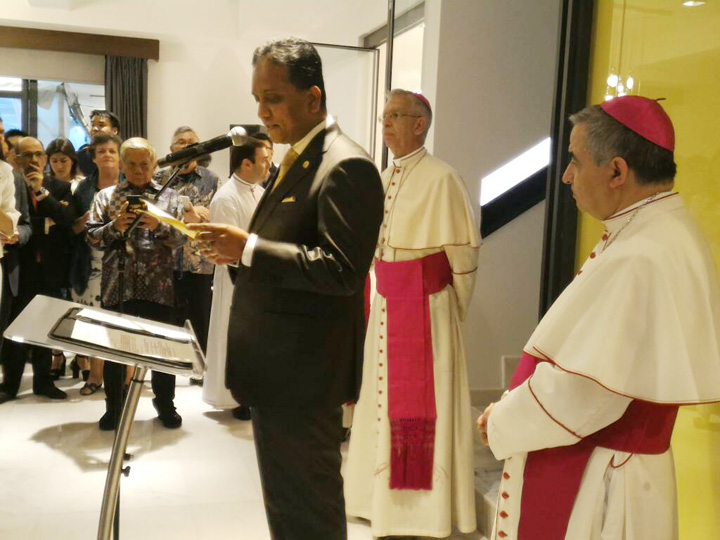
“It is my great pleasure to be here today and to convey to all of you the cordial greetings of His Holiness Pope Francis as we gather for the inauguration of the new offices and residence of the Apostolic Nunciature in Malaysia.

I greet in particular Cardinal Anthony Soter Fernandez and Bishop Sebastian Francis, President of the Bishops’ Conference, together with His Excellency [the Deputy Foreign Minister], here representing the Prime Minister and the members of the federal government. In a special way, I bring the greetings of Pope Francis to His Majesty Sultan Muhammad V, the Yang di-Pertuan Agong XV. The building we dedicate today has been made possible by the support of the Bishops’ Conference and of all those who are convinced of the importance and significance of establishing a permanent site of the Apostolic Nunciature in Malaysia. To all I express His Holiness’s heartfelt gratitude.

“The inauguration of this new Nunciature, and the desire of Malaysia and the Holy See to deepen the friendly ties we enjoy, are signs of our shared goal: to construct a more fraternal world where concord, justice and peace can flourish.” — Archbishop Giovanni Angelo Becciu, substitute of the Secretariat of State to Malaysia for the inauguration of the new Apostolic Nunciature in Kuala Lumpur


Article reproduced from Herald Malaysia online

Formation in Catholic ethos for the new millennium challenges ahead

The Archdiocesan Pastoral Institute (API) has initiated a strategic collaboration with the renowned Australian Catholic University (ACU) to conduct a two-year distance learning programme leading to the Graduate Certificate of Leadership and Catholic Culture (GCLCC).

The programme is conducted over four semesters from Nov 2017 to May 2019. Participants are required to undergo intensive study for five days per semester at API with the lecturers from ACU. In between the study periods, participants must submit their assignments to the lecturers who will assess the research for grading.

The modules in the programme are on Catholic Ethos and the Care of the Human Person, Catholic Social Thought in Practice, Ethics in a faith-based Context and Leading the Mission in the Marketplace.

The programme prepares dynamic robust leaders who are firmly founded on the history and heritage of the teachings of the Catholic Church with practical application and relevance on the identity of Catholic charism to make an impact for the Kingdom of God in the modern secular world.

The first unit was attended by 18 participants from Malaysia and Singapore. Daily Mass and group discussions helped them to navigate through the study programme.

The participants in the programme include youth leaders from ASAYO (Archdiocese Single Adults and Youth Office), deacons, parish workers and formation teachers from the three Dioceses of Penang, KL and Melaka- Johor, as well as senior managers from Mount Miriam Cancer Hospital Penang and Mount Alvernia Hospital Singapore.

The collaboration was the result of the forward-thinking initiative, planning and coordination since 2016 of FMDM Sr Cyrilla Baptist and Fr Clarence Devadass, ex- Director of API prior to his studies in Cambridge. Msgr Mitchel Anthony VG, who has taken over from Fr Clarence, saw the project through with the support of the three Arch/Bishops of Peninsula Malaysia.


Article reproduced from Herald Malaysia online
Vatican opens official chancery in Kuala Lumpur

KUALA LUMPUR: Diplomatic relations between Malaysia and the Holy See have been further strengthened with the opening of its official chancery here.

The inauguration of the Nunciature’s Residence and Chancery at Taman U-Thant on Nov 23 follows the setting up of ties between both sides in 2011.

Archbishop Angelo Becciu, who represented Pope Francis, said the new chancery was made possible with support from the Catholic Bishops’ Conference of Malaysia and “those convinced of the importance of establishing the permanent site of the Apostolic Nunciature in Malaysia.”

“To all, I express His Holiness’ heartfelt gratitude. This structure symbolises the friendly ties between Malaysia and the Holy See,” he said.

An Apostolic Nunciature is a top-level diplomatic mission of the Holy See, equivalent to an embassy. However, it does not issue visas nor does it have consulates.

The opening of the permanent residence and chancery of the Apostolic Nunciature in Malaysia would lend further impetus to elevate Malaysia and Holy See relations to greater heights, said Deputy Foreign Minister Datuk Sri Reezal Merican bin Naina Merican.

“Besides enabling further collective efforts at global peace building, we now have an essential platform on which to enhance other areas of bilateral cooperation such as in the education field,” he said at the opening ceremony.

Datuk Sri Reezal Merican, on behalf of Prime Minister Najib Abdul Razak, also congratulated Substitute of the Secretariat of State and Representative of Pope Francis, Archbishop Angelo Becciu and Apostolic Nuncio, Ambassador Extraordinary and Plenipotentiary of the Holy See to Malaysia Joseph Marino.

Also present was the first resident Ambassador of Malaysia to the Holy See, Bernard Giluk Dompok.

Merican said six years ago, on July 27, 2011, the Malaysian government took a positive step in establishing diplomatic relations, and since then, the ties between the two countries have witnessed a positive trajectory, based on mutual respect, understanding and underlined by the common desire to promote global peace and security.

“The commitment of Prime Minister (Najib) to foster stronger ties with the Holy See saw Malaysia opening its Embassy to the Holy See in March 2016.

“Another milestone in our ties was the productive visit of Foreign Minister Anifah Aman to the Holy See, during which the minister officially inaugurated the Malaysian Embassy to the Holy See in May 2017. These milestones, achieved within a relatively short span of time, would not have been possible without the seriousness and commitment of the government of Malaysia,” he said.

Merican said the Malaysian prime minister had once stated that Malaysia was committed to working with the Holy See in promoting reason and moderation in the fight against negative forces.

He said Malaysia, in itself, embodies the true meaning of harmony and the rights of every citizen and community are protected by the Federal Constitution, including the right to profess and practise one’s religion.

He said Malaysia has a thriving Catholic community who, along with other existing religious communities in Malaysia, are free to profess and practise their religion, adding that the prime minister (Najib) and the government have always been committed to safeguarding the welfare of every religious community in the country, including the Catholic faithful.

Archbishop Marino in his welcome address extended his sincere heartfelt welcome to one and all for the official opening of the residence and chancery.

Archbishop Marino, the first Nuncio to Malaysia was appointed by Pope Benedict XVI on January 16, 2013. Malaysia became the 179th state to establish diplomatic relations with the Holy See.

He expressed his gratitude to the Malaysian government which has offered much attention and assistance in the entire process of setting up the Nunciature in Kuala Lumpur, adding that, “a particular recognition to the various officials of the Foreign Minister whose professionalism and expertise were of valuable help to our Mission.” — Agencies & Vincent D’Silva


Article reproduced from Herald Malaysia online

Learning the changes to the Rite of Marriage

KUALA LUMPUR: A formation on Marriage and Liturgy was held on Nov 18 at the Community Centre of St John’s Cathedral.

One hundred and fifty-one participants from the different parishes attended the formation given by Msgr Leonard Lexson, the chairman of the Archdiocese Liturgy Commission of Kuala Lumpur Archdiocese.

This formation was held to give a better understanding on some of the changes to the Rite of Marriage which will come into effect on the First Sunday of Advent (Dec 3) for Malaysia, Singapore and Brunei.

After Lauds, Msgr Lexson led the participants through the historical development of the sacrament. He spoke, using scripture references, and the social customs and practices of the time to help the participants understand how the marriage rite has evolved.

He spoke on two areas: the order of celebrating marriage within Mass and without Mass.

For the celebration within Mass, he informed the participants on the two forms available for the priest to greet the couple.

He also explained some of the changes in the wordings which bring about a deeper understanding of the sacrament.

The books on the new rite were given to the clergy a couple of months ago. A session for the clergy will be arranged next year.

Archbishop Julian Leow was also present at the formation. “It is good for us to go through and understand the changes before giving sessions for couples intending to marry.”

“Understanding the rites make the sessions more meaningful. However, one of the best ways is to share your lives with these couples,” added Archbishop Leow.

Archbishop Leow asked for the participants’ patience in the implementation process as change is difficult.

Participants were advised to write in to litrugy@archkl.org for further clarification.


Article reproduced from Herald Malaysia online
BEC Hillview celebrates 33rd anniversary

IPOH: Formed in 1984, BEC Hillview, under the parish of St Michael, celebrated its 33rd anniversary recently.

The BEC has a history of inclusiveness. In its second year of formation, it had gathered more than 45 Catholic families. The BEC later split into two smaller groups for better management and to create stronger bonds amongst its members.

Today, this group of 12 families is helmed by a group leader from among the younger generation.

The gathering was at the home of Irene Chow, coupled with the celebration of the new liturgical year and the appointment of a new area group leader.

Pioneering area group leader Andrew Quah said that, through the BEC, the Church is brought into the homes of the parishioners.

“Most importantly, the family members ultimately realise the importance of lay people involvement and togetherness nurtured in line with the agenda and activities of the BEC that includes migrants,” he said.

He encouraged the attendees to ask questions so that everyone would appreciate and know what the BEC is all about, which would also further aid the growth of the BEC. The evening ended with a potluck fellowship among the members.


Article reproduced from Herald Malaysia online
error: Content is protected !!