Author Archives: Ken Wong

Elias Carmelite Family celebrates founder’s golden jubilee

At the altar L-R: Bp Cornelius Piong, Fr Yohanes Indrakusama (jubilarian), Fr Peter Hwang of Limbang, Fr Anthony Mikat, 13 Aug 2017, Golden Jubilee Mass, Kaingaran Tambunan

KAINGARAN, Tambunan – The Elias Carmelite Family celebrated its founder’s golden jubilee of priesthood on 13 Aug 2017 at St Mary Magdalene Chapel here.

Visitors from Indonesia, China, Sarawak joined the local Putri Karmel (Daughters of Carmel), Carmelitae Sancti Eliae (CSE) and Komunitas Tritunggal Mahakudus (KTM) in celebrating the 50 years of priesthood of their Founder, Father Yohanes Indrakusama OCarm, 79.

Bishop Cornelius Piong presided at the thanksgiving Mass.  Joining him and the jubilarian at the altar were CSE Superior General Rev Sergius Paulus, Rev Giovanni C Sugau CSE,  Rev Peter Hwang of Limbang,  Anthony Mikat, Bede Anthonius, Gilbert Lasius, Joseph Gapitang, and Mario Tong of China.

Young dancers in traditional attire led the entrance procession from the St John Catholic Retreat Centre to the chapel accompanied by the beating of the gongs.

In his homily, the bishop told some 500 people present that he came to know the jubilarian in 1984 while attending a Charismatic Renewal Convention in Indonesia.

When he became the bishop of Keningau in 1993, he welcomed the Putri Karmel into the diocese in 1997 where it took root and flourished on a 32-acre of land at Kaingaran Tambunan.

After the Mass, there was a fusion of Chinese and Murut cultures in the performances by the Fook Xing Dragon Unicorn Lion Dance Troupe Tambunan, firecrackers and fireworks display outside the retreat centre in spite of the inclement weather.

The reception was held at the hall below the chapel where a video clip on the life of the jubilarian was screened.  The Elias Carmelite Family also entertained the guests with a variety show.  An exhibition on the founder’s life and history of the Elias Carmelites was displayed outside the dining hall.

Born in 1938 in small East Java town into a Chinese family, the jubilarian began his novitiate in a Carmelite monastery in 1960. Ordained as a priest in 1967, he pursued his studies in theology in Rome and Paris and later worked in various parts of the country. In the mid-70s, he spent time in a hermitage involved in contemplative life.

He founded the Putri Karmel on 19 March 1982 in Ngadireso, a small village in Malang Diocese East Java, followed by the Carmelitae Sancti Eliae on 20 July 1986 and the Komunitas Tritunggal Mahakudus on 11 January 1987.

On 12 Jan 2013, the St John of the Cross Institute (philosophy and theology) in Pontianak West Kalimatan founded by the jubilarian was officially opened by the Pontianak Archbishop.

Putri Karmel is a religious community of women, whereas CSE is for men and KMT for lay people.

The two religious communities have the same spirituality, way of life and ministry. Fundamentally they follow the spirit of the Carmelite Rule and Traditions, accentuating the contemplative aspect, integrated with the Charismatic Renewal.

The  Charismatic Renewal brings about the experience of God in the power of the Holy Spirit, and the Carmelite Spirituality is a very rich tool to deepen it and settle it down.

The members may give counselling, retreats, seminars, or offer prayers for individuals.

Currently, there are 43 Putri Karmel Sisters, 16 CSE Brothers, and over 1,800 KTM members in Malaysia.  Aside from Indonesia and Malaysia, there are also communities in China, Italy and USA.

On 12 April 2017, Sister Maximilliane Soon became the first superior of Malaysia-China District with two communities each in Malaysia (Keningau and Sibu) and China (Xingtai Hebei Province in the North and Fuqing Fujian Province in the South) respectively while Sister Geraldine Marie is the local superior of Kaingaran.


Article reproduced from Catholic Archdiocese of Kota Kinabalu

DOPP drafter gives his take on its impact on diocesan life

PENAMPANG – The Diocesan Organisational Pastoral Plan (DOPP) of Kota Kinabalu Diocese was drafted by a core team in 1996.  It was accepted and launched on 16 Sept 1997.  Twenty years later (14 Aug 2017), Dominic Lim, one of the drafters, was asked to give his views on how it has affected the life of the diocese since then.

Asked on its positive impact, Lim, 60, said the desired end of the DOPP is the attainment of the Diocesan Vision viz to be acommunion of Christ-centred communities journeying together in the faith, hope and love of Jesus Christ, empowered by the Holy Spirit to build up the Kingdom of God.

In this area, he continued, many of the faithful have been active in church groups such as parish committees, basic ecclesial communities, and quite a number have made long-term commitments in ecclesial movements.

Lim noted that there is a greater sense of belonging to the diocesan family through participation in diocesan programmes organised such as Jubilee Year 2000, Diocesan Silver Jubilee 2001-2002, Eucharistic Congress 2004, ordinations and anniversaries of clergy and religious, the Priestly Year, the Year for Consecrated Life, Jubilee Year of Mercy, and others.

“I see these as positive signs of moving towards a communion of Christ-centred communities, a greater effort to journey together. The journey towards the dream will take time. DOPP as a Pastoral Plan has only a 7-year timeframe and in fact it has expired. It is too short a time to achieve our Vision. But the signs are there. We just have to continue to remind each other of our Vision, move together towards  that common direction and continue to allow the Spirit to empower us,” he said.

As for striking changes, Lim said, “We have moved away from a centralised pastoral structure (PAX Board of Directors) that decided the direction we moved as a diocese to a more consultative and participative approach with the Vision as our common direction.”

While he admitted that there is still much room for improvement, the parish community is now able to plan and move from where they are towards the Vision though some [parishes] are still struggling to “grasp the elements of the Vision, others are already implementing the Objectives stated in the DOPP.”

He saw this as “something more realistic in being Church because the maturity level of our communities differs from place to place.”

Lim pointed out that the emphasis on ongoing personal and communal conversion is “the key” to a total and integral renewal.

This, he added, is enhanced by living out the commitments spelt out in the Mission Statement, that is, living out a life of prayer nourished by the sacraments and the Word, guided by church teachings, unity in communities, respecting values of other faiths, responsible stewardship of the environment, and promoting justice and peace in society.

Lim noted that since the DOPP, there are more people attending daily Mass and coming forward to help in RCIA, Alpha and other church activities.  Many seminars, recollections, retreats and other faith formation programmes have been conducted.  There are also more inter-church activities.

“And there has been a greater awareness of our faith response to societal issues. All these were not very visible 20 years ago,” he said.

Lim, who works in the archdiocesan secretariat, pointed out that the mission ad gentes of the archdiocese was enhanced through the setting up of new pastoral structures such as the Social Communications Commission and Human Development Commission, the Montfort Youth Training Centre, the Sacred Heart Charity, Pusat Kebajikan Good Shepherd and other welfare programmes of the lay movements, and the strengthening of the church’s role in mission schools.

As for ways and means to maintain the DOPP spirit, Lim recalled the speech of Bishop John Lee during the launching of DOPP on 16 Sept 1997 at the Sacred Heart Cathedral.  The bishop admitted that the DOPP was quite technical but as long as “we adopted and lived the spirit behind the whole planning exercise, we would have achieved something – our new way of being Church begins not in what we do but how we live with each other in the Church and with the world around us.”

He said that to maintain the spirit, streamers on the Diocesan Vision and Mission were printed and hung on the walls of many chapels and halls to remind the people of their common direction in pastoral life.

In addition, Lim continued, the Diocesan Prayer was recited and continues to be recited on Sundays and feast days.

“The seminar on pastoring together in 1998 had laid the foundation for a better understanding of collaborative ministry while the bishop’s keynote addresses at subsequent PAX Assemblies after 1997 touched on elements of the Diocesan Vision to promote and maintain the DOPP spirit,” he added.

Lim noted that the changes from PAX Board of Directors to Diocesan Pastoral Council in 1998, from Parish Council to Parish Pastoral Council in 1999 had concretised collaboration among the clergy, religious and laity in pastoral leadership and mission of the Church in line with the Diocesan Vision.

The DOPP drafter pointed out: “DOPP as a Pastoral Plan was overtaken by events since its launching.  The two big events – Great Jubilee Year 2000 and the Silver Jubilee of the Diocese in 2002 were not anticipated during the formulation of the Plan but somehow the diocese was able to blend them into the spirit of the DOPP.”

Lim noted that though the DOPP implementation might not have been strictly according to the Timelines stated in the document, many of its Enabling Objectives have been carried out in various forms over the past 20 years.

In conclusion, he suggested that the term DOPP be dropped since the Plan has already expired.  Instead, the archdiocese should just focus on the Vision and Mission.

Another member of the DOPP Core Team, Magdalene Chu, described the process of coming together and thinking through the vision and mission of the local diocese was good.  She said it made concrete the universal mission of the church in the local church context.

The Archdiocesan Prayer still being said, she added, is good as it helps to remind everyone of the mission and needs of the archdiocese. (KK became an archdiocese in 2008).


Article reproduced from Catholic Archdiocese of Kota Kinabalu
DOPP turns 20

KOTA KINABALU – On 16 September 2017, the Kota Kinabalu Archdiocese will celebrate the 20th anniversary of the launching of its Diocesan Organisational Pastoral Plan (DOPP).

This document was launched on 16 September 1997 by then Bishop John Lee at the Sacred Heart Cathedral Kota Kinabalu in the presence of Archbishop Luigi Bressan, apostolic delegate in Malaysia.

At the launching, Bishop Lee said that the DOPP has spelt out the Vision, “the ideal Church that we want to be” but stressed that what is more important is “for us to uphold and live the spirit behind the whole planning exercise, namely personal and communal renewal in a new way of being Church.”

The need for the DOPP was prompted by a response to the increasing new pastoral challenges that came along in the diocesan journey as local Church.In 1996, one hundred sixty-four (164) delegates comprising bishop, priests, religious and laity from the whole diocese assembled to formulate the Vision and Mission of KK Diocese.  In September 1997 the Vision and Mission were formally adopted as both the rallying point and direction of the diocese.  In other words, they are the overall and continuing goal of all that we hope to achieve in our pastoral works, where all our available resources are to be used.

In 1996, one hundred sixty-four delegates comprising bishop, priests, religious and laity from the whole diocese assembled to formulate the Vision and Mission of KK Diocese. The 1996 workshop was the first effort of its kind to assess the realities and identify the problems and needs of the KK diocese, which was established in 1976.

In September 1997 the Vision and Mission were formally adopted as both the rallying point and direction of the diocese.

The DOPP has four main components: (a) Pastoral analysis of the Diocese (b) Proposed solutions (c) Common direction and (d) Action Plan.

Though quite technical, the essence of the document underlies some major concerns: (i) a deeper understanding of the Word of God (ii) the need for an understanding of the Church as Communion (ecclesiology of communion) (iii) the participation of all the people of God in the Church and (iv) the relationship between the Church and the world.

These four-fold concerns are in line with the concerns of Vatican II (Lumen Gentium 1964 & Gaudium et Spes 1965).

The DOPP, as a seven-year plan (1998-2004), expired by end of 2004. Bishop Lee declared in his January 2005 Pastoral Letter that “2005 is a time for evaluation, to see how much we have achieved in the process of renewal and how far we have journeyed towards our Vision.”

The whole diocese was mobilised to undertake the exercise. One major difference was the emphasis on learning. The exercise was to be “process-oriented” not “result-oriented.”

By emphasising the importance of the learning process, the whole exercise took on a pastoral tone. It provided the opportunity for self-examination.

Dominic Lim, one of those who formulated the Plan, said that the term DOPP should no longer be applied since the Plan has already expired.  Instead, the Church should focus on the Vision and Mission.

In March 2014, the Archdiocesan Pastoral Council (APC) 2014-17 identified three critical concerns the Church needs to be aware of, i.e. apathy, secularisation and Islamisation.

It was argued that apathy is an internal weakness.  Such attitude could jeopardise the evangelising mission in building the Kingdom of God.  Secularisation and Islamisation are external forces which could undermine the faith of the people.  The degree of seriousness of these threats varies from parish to parish.  Nevertheless, they were reported as a prevailing phenomenon all over the archdiocese during the 2015 PAX Assembly.  The APC felt the need to address these concerns seriously.

The degree of seriousness of these threats varies from parish to parish.  Nevertheless, they were reported as a prevailing phenomenon all over the archdiocese during the 2015 PAX Assembly.  The APC felt the need to address these concerns seriously.

The three concerns were tabled in the 2015 PAX Assembly.  Subsequently, the archdiocese adopted a Pastoral Thrust for the next two years where every pastoral agent and institute, every community and family, and every baptised Catholic are to rally together to tackle the concerns.  The Thrust has a threefold movement which can either be simultaneously carried out or move at the level according to the need of the community.

(a) Go Inward

This is an introspective movement – self-examination, reviewing and renewing of one’s relationship with God and with one another.  By doing so it aims for a “conversion of heart and mind” where one becomes more convinced of one’s faith and will not be easily swayed by external influences.

How does one “go inward?”  In the Mission Statement of our archdiocese, concrete commitments are spelt out: an ongoing personal and communal renewal, a life of prayer nourished by the sacraments, and living the Word of God guided by the teachings of the Church.  Through this Mission Statement, our archdiocese (clergy, religious and laity) commit to returning to the basics – prayer, sacraments and Word of God.  To “go inward” is to get into the inner self to discover one’s true identity as a child of God with the help of prayer, sacraments and the Word of God, and live accordingly.

(b) Go Smaller

Facing the onslaught of external pressures, support from others in our faith journey is needed.  As our congregations get bigger, one can be reduced to mere statistics or number. There is a need to go smaller in order to nurture warmth and the sense of belonging to a community (e.g. BEC) for support. Go smaller may also imply reviewing our pastoral structures to make them more responsive to pastoral demands, and to optimise our resources (human and material) to make them aligned to our pastoral strategies in addressing the three critical concerns.

(c) Go Outward

Though a “little flock,” our baptismal vocation has set us apart to be “light of the world” and “salt of the earth,” to transform our society through words and deeds.  To go outward implies, among others, living our faith in our multi-religious society, involvement in social issues, caring for others outside of our circle, working with people of other faiths in addressing common issues, going beyond church boundaries, getting our hands dirty and so forth.  It is through our life witnessing that others recognise the gem of our faith and are attracted to the living Gospel in us.

“I prefer a church which is bruised, hurting and dirty because it has been out on the streets,” (Francis, Evangelii Gaudium).


Article reproduced from Catholic Archdiocese of Kota Kinabalu
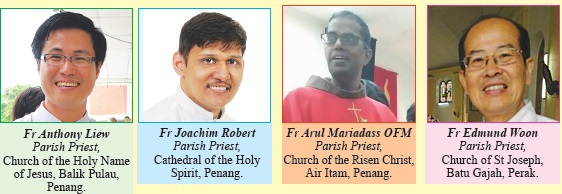
Priests’ transfer in the Diocese of Penang

PENANG: In a letter to HERALD, Bishop Sebastian Francis has indicated the transfer of some priests in the Penang

Diocese effective May 1, 2017:

Msgr Henry Rajoo Parish Administrator, Church of the Sacred Heart of Jesus, Kulim, Kedah. Msgr Henry is also the Parish Priest of the Church of St Anne, Bukit Mertajam

Fr Victor Louis Parish Administrator, Church of Christ the King, Sungai Petani, Kedah. Fr Victor is also the Parish Priest of the Church of the Nativity of the Blessed Virgin Mary in Butterworth.

Fr Anthony Pillai Assistant Parish Priest Church of Christ the King, Sungai Petani, Kedah.

Fr Oliver Tham OFM Assistant Parish Priest, Church of the Risen Christ, Air Itam, Penang.

Fr Maiccal Sinnappan Assistant Parish Priest, City Parish, Penang.

Article reproduced from Herald Malaysia online

A delegation from Cambodia visits Sacred Heart Church

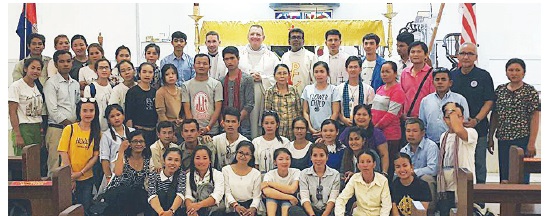
A delegation from Cambodia, led by the Apostolic Vicar of Phnom Penh, visited the Church of the Sacred Heart of Jesus (SHJ) in Jalan Peel on July 28.

Bishop Olivier Schmitthaeusler MEP, aged 47, who heads the Apostolic Vicariate of Phnom Penh, together with Fr Damien MEP and Cambodian Fr Ly and their 49 Cambodian lay Catholics (aged from 25 to 60 years old) were greeted by SHJ parish priest, Fr Edwin Peter.

The entourage was on an exposure programme to Kuala Lumpur and Penang. Earlier, they paid a courtesy call to Archbishop Julian Leow, after which they visited the HIV Centre in Batu Arang, Selangor.

The visitors participated in the Chaplet and Prayers to the Sacred Heart of Jesus prior to the 7.00pm Mass presided by Fr Edwin and concelebrated with Bishop Olivier, Fr Ly and Fr Damien.

After Mass, everyone adjourned for fellowship in the church courtyard. Joining them was Archbishop Emeritus Murphy Pakiam.

Bishop Oliver, who has been in Cambodia for 19 years, and Fr Damien, are both French. They are missionaries sent to Cambodia, under the Paris Foreign Missions Society (MEP).

After dinner, the Cambodian delgation attended a briefing by Fondacio Malaysia at the Bangunan Dominic Vandargon parish Community Centre. The briefing was about their activities, especially the Youth Leadership and Development Centre (YLDC) which aims to reach out to the poor, the migrants and the refugees. The skills provided in this programme are conversational English and Computer literacy to help them to find jobs in Kuala Lumpur.

Among the Cambodian delegation was Mr Sovanna, who is the director of the national social communication, office in Cambodia. The Cambodian delegation was in Penang July 29-30 where they attended the feast of St Anne and met with Bishop Sebastian Francis.

There are around 20,000 Catholics in Cambodia which represents only 0.15 per cent of the total population. There are no dioceses, but there are three territorial jurisdictions — one Apostolic Vicariate and two Apostolic Prefectures.

According to Bishop Olivier, there are 200 missionaries from 25 nationalities, including 10 MEP priests currently serving in Cambodia. By Bernard Anthony


Article reproduced from Herald Malaysia online


SIC celebrates parish feastday

This year’s Parish Feastday Triduum themed Be Disciples of Hope (Creative, Inclusive & Bridge Building), culminated with a multilingual Mass on Monday, July 31 at St Ignatius Church (SIC). The Eucharistic celebration at 8.00pm coincided with the feastday of St Ignatius of Loyola, the patron saint of SIC and founder of the Society of Jesus who passed away 461 years ago. Representatives from both English- and Mandarin-speaking Basic Ecclesial Communities (BECs) and ministries processed into church before the Mass started.

Fr George Harrison, parish priest from the Church of the Visitation, Seremban, was the main celebrant, with SIC parish priest Fr Andrew Wong CDD, assistant parish priest Fr Lawrence Ng CDD and Fr Francis Ng CDD as concelebrants.

In his homily, Fr George advised the parishioners to not just pray, pay and obey. They should not just be onlookers but to also serve in church ministries and BECs. They should reach out to those outside the church, such as the migrants, visit the homebound, the suffering and the sick in hospitals and build bridges with people of other faiths. They were encouraged to be active members of the Body of Christ.

At the close of Mass, Fr Wong thanked his fellow priests and organisers who had made the event a success. Thereafter, everyone was invited to a fellowship.

On July 29, the first day of the Triduum, Fr VA Michael (parish priest, Church of St Paul the Hermit, Bestari Jaya) was the main celebrant at the 6.00pm sunset Mass with a focus on healing. Parishioners had the opportunity to be prayed over for healing after the Mass. Concurrently at the Costantini Community Centre, Fr Aloysius Tan, parish priest from the Church of the Sacred Heart, Kampar, Perak, was the main celebrant at the sunset Mass for Mandarin-speaking parishioners. Fr Tan also celebrated Masses at 6.45am and 11.15am (Mandarin) July 30 during which he focused on Being Creative.

During the 8.45am Mass celebrated by Fr Alberto Irenus SJ, assistant parish priest from the Church of St Francis Xavier, Petaling Jaya, the homily was about the importance of Being Inclusive. He said that everyone is welcome in the Kingdom of God. However, in the Church, the Kingdom of God on earth, parishioners serve in ministries geared to their talents and capabilities.

Fr Gregory Chan, assistant parish priest from the Church of the Assumption, Petaling Jaya focused on Bridge Building in his homily at the 6.00pm Mass.

A movie titled Ignacio de Loyola on the life of SIC’s patron saint was screened at 8.00pm. Other activities organised as part of the Triduum included a nine-day Novena to St Ignatius, Liturgy of the Hours, and recitations of the rosary and Litany of St Ignatius.


Article reproduced from Herald Malaysia online

Over 25 participants attend inaugural BM catechists training course

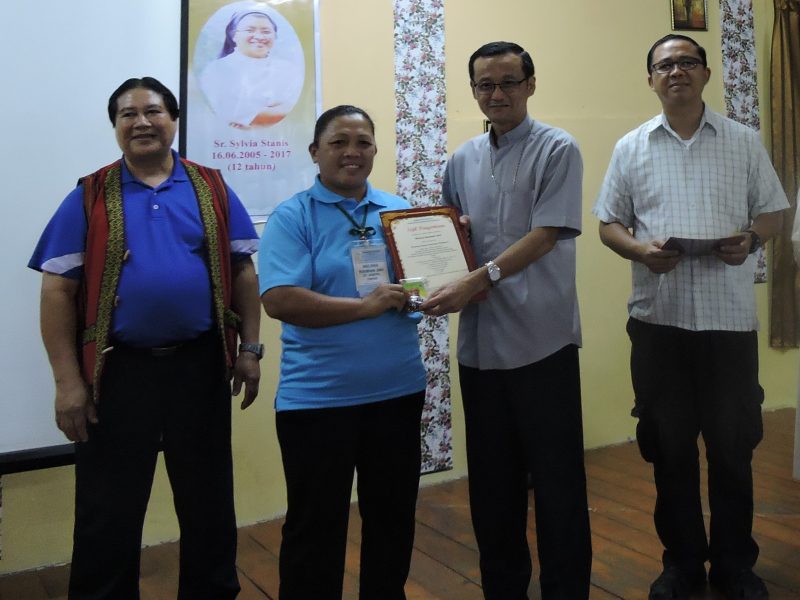
One of the participants receives his certificate of attendance from Abp Wong, flanked by Fr Yasun (L) and Fr Stephen (R).

BUNDU TUHAN – Over 25 participants attended the inaugural BM training courses f0r catechists at the Bundu Tuhan Retreat Centre here in June 2017.

Twenty-nine catechists attended Level 1 (June 12-July 7) while 27 enrolled in Level 2 (July 9-21).

The two courses were organised jointly by the Archdiocesan Catechetical Commission and the Persatuan Katekis (PEKA).

Previous courses were conducted in English under the late Jesuit Father Peter Kim in the 1990s.

Father Nicholas Stephen, spiritual adviser of the commission, officially launched the course in the stead of Archbishop John Wong.

Franciscan Sister Dariah Ajap said the training programme was held because there is a felt need to have trained and well-equipped catechists in the archdiocese, not only to preside at services in the absence of a priest but also to be prayer leaders on various occasions.

To address the need, Abp Wong tasked the Catechetical Commission to organise and facilitate the training, with the involvement of priests, religious and lay leaders as speakers.

Topics covered during the course include Scriptures, Church and her documents, Prayer and Worship/Liturgy, Catechetics, Leadership, Spirituality and Vocation of Catechists, Missiology,  and practicum in the chapel outstations.

Level 3 has been scheduled for Sept 8-24 at the same venue for those who have taken Levels 1 and 2 and for those who are parish catechists.

At the end of the course, Abp Wong presented the certificates of attendance to the participants.

At the closing Mass, the archbishop reminded the participants to constantly read the Word of God, receive the Sacraments frequently, obey the commandments always, and to preach the Good News to all through their life witness.

The Jul 21 closing event was also an opportunity for the attendees to witness the launching of  Father Bruno Yasun’s “Pengenalan Alkitab” (Introduction to the Bible)  by the archbishop. The book is available for sale now.

All catechists who have attended the course will continue their services in their respective parishes. For the newly trained catechists, their parish priests will be the ones to give them their  assignments. – catecomkk


Article reproduced from Catholic Archdiocese of Kota Kinabalu
India to host next Asian Youth Day in 2020

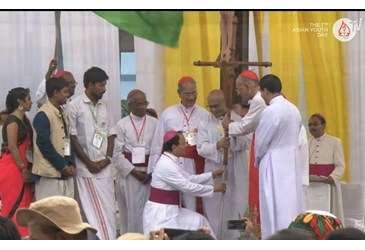
Card Gracias, Archbishop of Bombay, together with Indian Church officials and some of the Indian youth delegation receive the simple bamboo AYD cross from their Indonesian counterparts for the next AYD to take place in three years’ time.

The next Asian Youth Day will take place in India in 2020, the second time the South Asian nation will be hosting the continental-level Catholic Church event since 2003, the Vatican Radio announced on 7 Aug 2017.

Indian Cardinal Oswald Gracias made the announcement on Aug 6 at the end of the concluding Mass of the 7th Asian Youth Day (AYD7)which he presided over in Yogyakarta, Indonesia.

The venue of the AYD8 will be discussed and decided upon by the Catholic Bishops’ Conference of India (CBCI).

Among those who flanked Card Gracias, the main celebrant, at the altar were Filipino Cardinal Luis Antonio Tagle of Manila and Archbishop Ignatius Suharyo of Jakarta, who delivered the homily in Bahasa Indonesia.

“We do realise our differences: We are of different nationalities, different languages, different cultures, and so on,” noted the archbishop who is president of Indonesia’s bishops’ conference (KWI).  “However, in this event, we do realise and experience that those differences cannot separate us, but the differences show the richness of the united humanity instead. It proves that the power of faith, hope and love unites us.”

Abp Suharyo wished that the AYD7 help the young people to “diligently and faithfully live out the Gospel so that we may be filled with the joy of the Gospel.”

Thus, he added,  “our life could mirror the glory of the Lord, which changes our lives.”

The Asian Youth Day in Indonesia, on the theme, “Joyful Asian Youth! Living The Gospel in Multicultural Asia,” was divided into three phases.

It began with over 2000 participants  from 21 Asian countries living with local families in the country’s 11 dioceses, July 30-August 2.  The delegates then converged in Yogyakarta, Indonesia’s cultural and intellectual heartland, for the main event, Aug 2-6, which concluded on Sunday with a Mass, marked by a rich display of cultural diversity that both Indonesia and Asia are famous for.

This was evident in the flags, including of the Vatican, traditional and ethnic costumes, decoration, singing, music, and dancing accompanied by traditional musical and percussion instruments, both during and after the final Mass.

While the young people headed back home, the youth animators and ministers remained behind for the final phase of the AYD7 – the Asian Youth Ministers’ Meeting (AYMM) in Yogyakarta, Aug 6-9.

The AYD featured talks and workshops on aimed at building mutual respect in Asia’s diverse, multicultural population, caring for the environment and learning how to be missionaries in a digital world.   As part of the multicultural aspect and in an effort to address growing fundamentalism in the area, the event hosted several encounters between Christian, Islamic and other religious leaders.

Among the participants in the AYD7 were 52 bishops, 6 cardinals, 158 priests and 41 men and women religious. Among Asia’s prominent Catholic leaders at the meet were Cardinal Gracias, the president of the Federation of Asian Bishops’ Conferences (FABC) and member of the Pope’s “C9” council of cardinal advisers, Bangladeshi Card Patrick D’Rozario of Dhaka, the chairman of FABC’s Office of Laity and Family, under which comes the Youth Desk that organises the AYDs in collaboration with the host bishops’ conference, and Card Tagle, the president of Caritas Internationalis, the federation of national Catholic charity organisations worldwide.

Among several Indonesian government authorities at the closing Mass were Vice President Muhammad Jusuf Kalla and Governor Sultan Hamengku Buwono X of Yogyakarta.

Held for the first time in Hua Hin, Thailand, in 1999, AYDs have been held in intervals of two, three ‎and five years.   Taipei, Taiwan hosted it in 2001, followed by Bangalore, India in 2003, Hong Kong in 2006,  Imus, the Philippines in 2009 and Daejeon, South Korea, in 2014, which Pope Francis attended. – Vatican Radio


Article reproduced from Catholic Archdiocese of Kota Kinabalu
FSJV launches aspirants website at third thanksgiving dinner

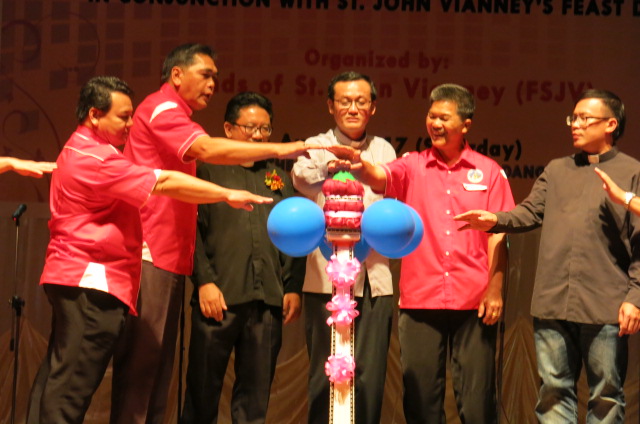
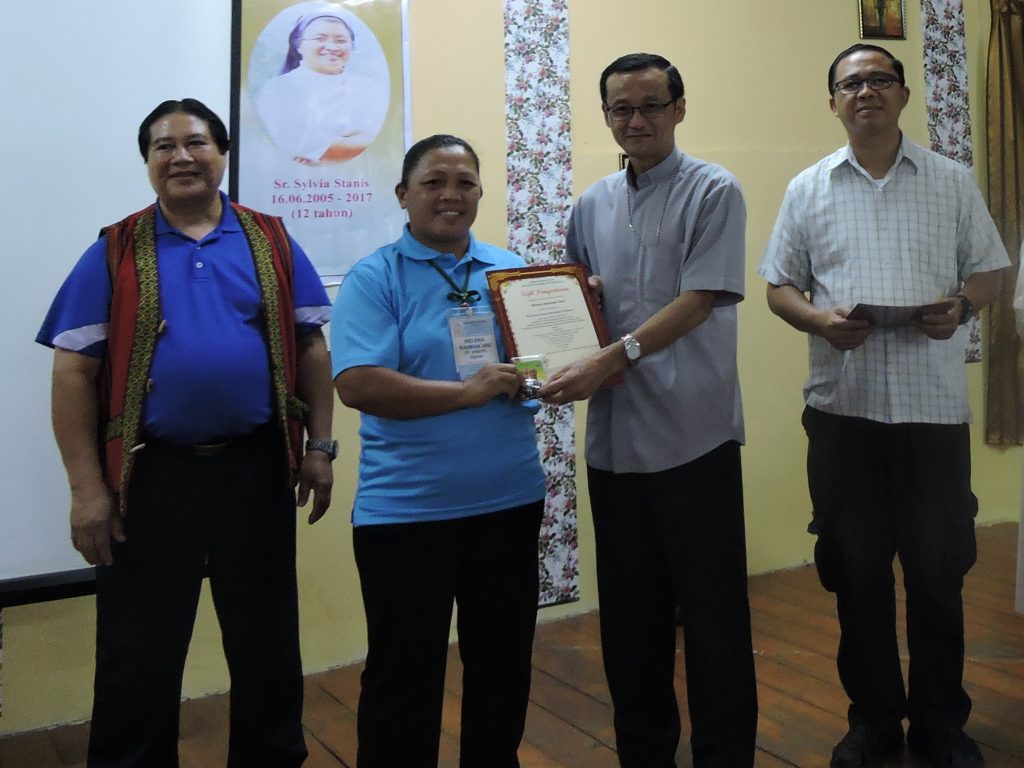
L-R: Anjumal (2nd L),  Abp Wong, Peter Suking (FSJV head), Fr Kiun stretch out their hands to launch the website while Fr Atin (3rd L) looks on, 5 Aug 2017, Bukit Padang.

BUKIT PADANG – The Friends of St John Vianney (FSJV) launched its website for the diocesan aspirants at its third thanksgiving dinner at the Putera Theatre Ballroom here on 5 Aug 2017.

The launch was officiated jointly by Archbishop John Wong, FSJV Adviser Father Wilfred Atin, Project Director Rayner Anjumal, and  FSJV officials.

The website – www. cdcaspirants.com – is to update news on activities and events of the aspirants.

Around 800 people turned up for the dinner including Archbishop Emeritus John Lee, Father Thomas Madanan, Father Mitchelly Kiun and some religious sisters.

In his speech, Anjumal explained how the website project came about while both Abp Wong and Fr Atin thanked all benefactors and friends for their spiritual and material help in the past year.

At the end of his speech, Fr Atin announced that the new director of the aspirants will be Father Joshua Liew who will assume the post next year.  However, Fr Liew was not present at the dinner because he was attending the 7th Asian Youth Day in Indonesia, being the spiritual adviser of the youth commission.

Formed in 2011 under Fr Atin, the FSJV is a group of people supporting the aspirants residing at the Catholic Archdiocesan Centre Penampang materially and spiritually.  It has also provided the teachers needed to help aspirants pass MUET so that they could proceed to the next stage of formation.

Article reproduced from Catholic Archdiocese of Kota Kinabalu
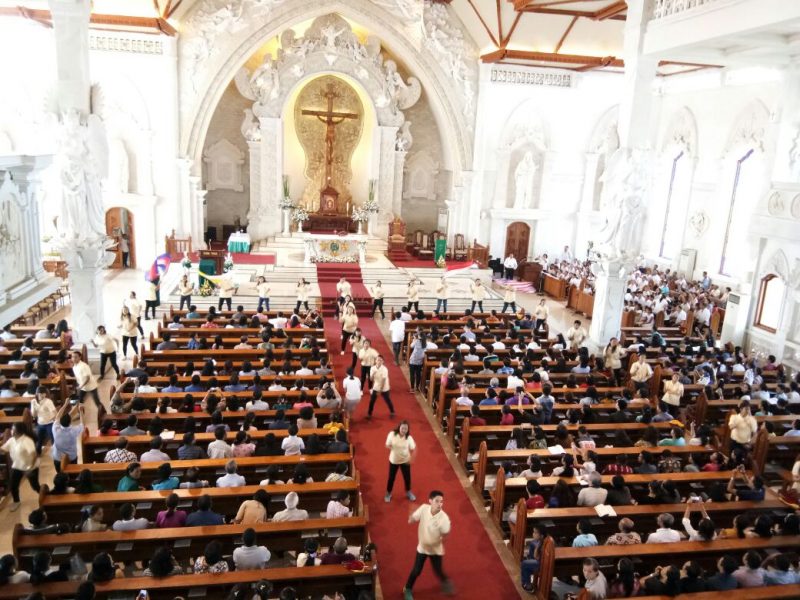
Denpasar, young people from Malaysia and Cambodia for Asian Youth Day ‘Days in the Diocese’

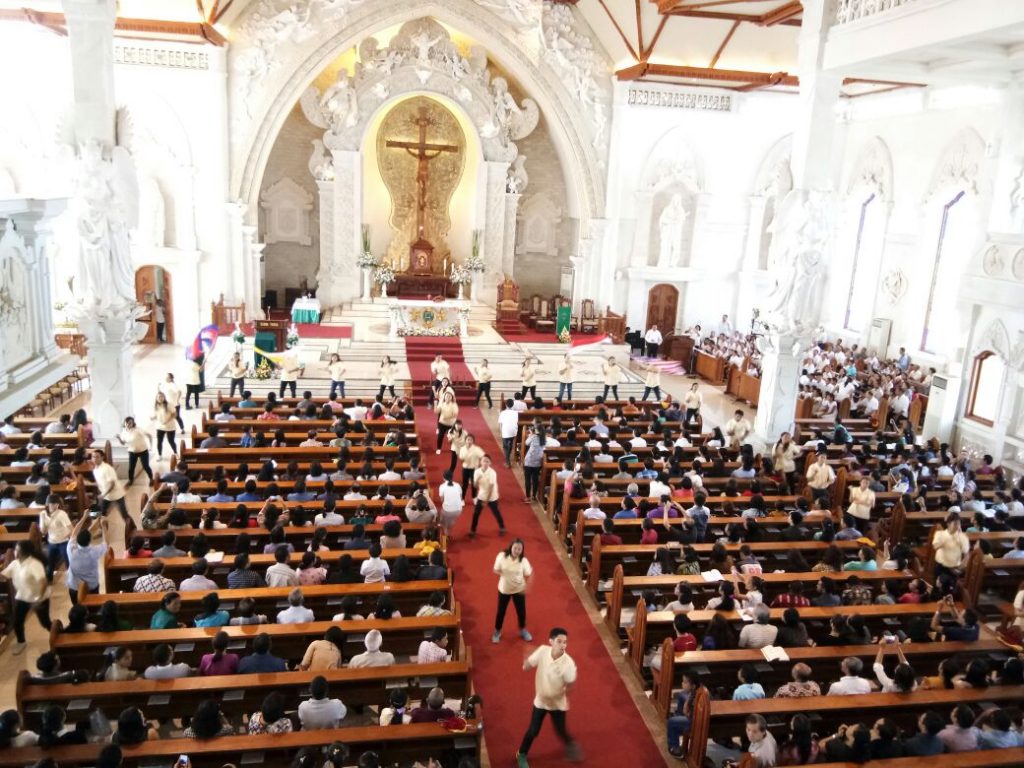
More than 150 young delegates from Cambodia, Malaysia, and five Indonesian dioceses have been assigned to 10 parishes of the Denpasar diocese in Bali on the first stage of the Asian Youth Day (AYD). This stage involved contact with families and other young people in the diocese in a sharing experience of faith and life. This first stage of the AYD is called “Days in the Diocese” and lasts from the day of arrival (July 29) until August 2.

The central part of Ayd will be held from August 2 to 6 in Yogyakarta, Semarang diocese, and will develop around the theme for this year’s edition: “Joyful Asia Youth, Living the Gospel in Multicultural Asia”.

This year’s theme underlines the need for young Asians to follow Christ amidst the immense variety of culture and situations that dominate Asia. In this, Indonesia is a model: a country of over 260 million people, the fourth in the world), largely Muslim (86.1%), who live with minorities of Protestant Christians (5.7%), Catholics ( 3%), Hindu (1.8%), Confucians and others.

Roselinah Francis, of the Diocese of Keningan (Malaysia), expresses her appreciation for “Days in the Diocese”: “They allow us to have first-hand experiences on the expression of people’s faith. I am happy to be here in Bali, where there is a Hindu majority. The faith of Catholics here in Denpasar is really touching. ” Roselinah is one of the youth leaders of her diocese. She also participated in the previous AYD edition in Seoul, which also saw the presence of Pope Francis.

About 100 Malaysian young people who arrived in Indonesia are in Denpasar and Palembang diocese.

Nhem Sophead, Phnom Penh, is an kindergarten teacher. Speaking to AsiaNews she says: “I feel good here in Bali, meeting Catholic friends and families and exchanging facts and experiences. All this was possible thanks to Ayd. ” “Living Ayd in a country like Indonesia, with an Islamic majority – she adds – gives pause for thought to Cambodians who live in a Buddhist majority nation.”

Gregorius Ambot, 33, of Ruteng (Indonesia) is “grateful for all these young people here in Bali who are doing their best to make us feel at home.”

In addition to living with families, the days will be marked by Mass, by sharing of faith, Bible readings, drama, and dances.


Article reproduced from Herald Malaysia online
error: Content is protected !!